Statistics
Last Updated
Jun 10, 2026
Table of contents
College is one of the most sleep deprived stretches of adult life. Late nights, early classes, part-time jobs, and a culture that treats the all-nighter as a badge of honor leave most students running a chronic deficit. The research is strikingly consistent across decades: the majority of college students do not get enough sleep, most rate their sleep as poor, and the shortfall tracks closely with lower grades and worse mental health. Here is sleep deprivation among college students by the numbers.
The headline numbers
College sleep in four figures.
How common it is
Most students do not get enough sleep.
Across the literature, roughly 70% of college students report getting insufficient sleep, and only about 30% regularly get the amount their bodies need, according to a widely cited review in Nature and Science of Sleep. Young adults aged 18 to 25 need 7 to 9 hours a night, and adults generally need at least 7, yet most students fall short on school nights.
Share of college students reporting insufficient sleep. Source: Hershner and Chervin, Nature and Science of Sleep (2014).
Sleep quality
And most rate their sleep as poor.
It is not only about hours. In a study of more than 1,100 students published in the Journal of Adolescent Health, over 60% scored as poor-quality sleepers on a standard clinical scale, meaning fragmented, unrefreshing sleep even when the total hours looked adequate.
Self-reported sleep quality, scored on the Pittsburgh Sleep Quality Index (a score above 5 indicates poor quality). Source: Lund et al., Journal of Adolescent Health (2010).
The daytime cost
Half feel sleepy through the day.
About 50% of college students report regular daytime sleepiness, markedly higher than in the general adult population. That sleepiness shows up as trouble focusing in class, microsleeps during lectures, and a heavier reliance on caffeine to get through the day.
Share of college students reporting daytime sleepiness. Source: Hershner and Chervin, Nature and Science of Sleep (2014).
The deficit
Below the recommended range.
Estimates of average sleep cluster around 6 to 7 hours on school nights, under the 7 to 9 hour range recommended for young adults. An hour short every night adds up to roughly a full night of lost sleep across a single week.
Average weeknight sleep among college students against the recommended range. Estimates cluster at 6 to 7 hours. Sources: Lund et al. (2010); National Sleep Foundation duration recommendations.
The academic cost
It shows up in grades.
Sleep is not a competitor with study time, it is part of how studying sticks. An MIT study published in npj Science of Learning tracked students' sleep with wearables across a full semester and found that sleep duration, quality, and consistency together explained close to a quarter of the variation in academic performance, and that better, more regular sleep predicted higher grades. Earlier work in the Journal of American College Health found that among common health behaviors, sleep habits were the single strongest correlate of first-year GPA.
Share of the variation in students' academic performance explained by sleep duration, quality, and consistency combined. Source: Okano et al., npj Science of Learning (2019).
All-nighters
All-nighters are common, and they backfire.
Around 60% of students report pulling at least one all-nighter, usually to cram or finish work. The research is blunt about the tradeoff, per Behavioral Sleep Medicine: students who rely on all-nighters tend to have lower grade point averages, not higher, because the lost sleep undercuts the memory consolidation that turns studying into recall.
Share of college students who report ever pulling an all-nighter. Source: Thacher, Behavioral Sleep Medicine (2008).
Why it feels like being drunk
Seventeen hours awake equals a drink.
There is a physiological reason an all-nighter feels like impairment. A landmark study in Occupational and Environmental Medicine found that after 17 to 19 hours without sleep, performance on attention and reaction tasks fell to the level of a person with a 0.05% blood alcohol concentration. After about 24 hours awake, it matched roughly 0.10%, higher than the 0.08% legal driving limit in most of the United States.
Blood-alcohol-equivalent impairment by hours of wakefulness, on attention and reaction tasks. Source: Williamson and Feyer, Occupational and Environmental Medicine (2000).
The basics
College sleep at a glance.
| Measure | Figure |
|---|---|
| Recommended for young adults (18 to 25) | 7 to 9 hrs |
| Recommended minimum for adults | 7+ hrs |
| Typical student weeknight sleep | ~6 to 7 hrs |
| Report insufficient sleep | ~70% |
| Poor-quality sleepers (clinical scale) | ~60% |
| Report daytime sleepiness | ~50% |
| Have pulled at least one all-nighter | ~60% |
Sources: Hershner and Chervin (2014); Lund et al. (2010); Thacher (2008); National Sleep Foundation. Figures are rounded and drawn from US college samples.
What drives it
Why students sleep badly.
The causes are well documented, and most are specific to the way student life is structured rather than to anything medical.
| Driver | Why it hurts sleep |
|---|---|
| Irregular schedules and social jetlag | Shifting bed and wake times, especially weekend catch-up, desynchronize the body clock |
| Screens and light at night | Evening light suppresses melatonin and delays sleep onset |
| Caffeine and energy drinks | A long half-life keeps the brain alert for hours after the last cup |
| Stress and anxiety | Raise arousal and rumination, pushing sleep later |
| Alcohol | Speeds sleep onset but fragments sleep and cuts REM later in the night |
| Late study sessions and long naps | Push the body clock back and reduce night-time sleep pressure |
Source: Hershner and Chervin, Nature and Science of Sleep (2014).
What it costs
How the deficit shows up.
| Domain | Effect of short sleep |
|---|---|
| Attention and reaction time | After 17+ hours awake, impairment matches a 0.05% blood alcohol level |
| Memory | Weaker consolidation of material studied that day |
| Mood | Higher anxiety and more depressive symptoms |
| Academics | Lower GPA; sleep explains close to 25% of performance variation |
| Health | More frequent illness and missed days |
| Safety | Greater drowsy-driving risk, especially after all-nighters |
Sources: Williamson and Feyer (2000); Okano et al. (2019); Hershner and Chervin (2014).
The takeaway
The cheapest upgrade on campus.
Put together, the picture is clear and stubbornly consistent across decades of research. Most students are short on sleep, most sleep poorly, and the deficit quietly taxes their grades, their mood, and their health. Unlike almost anything else that improves academic performance, sleep costs nothing and competes with very little. For a student chasing better grades, protecting sleep is closer to a free upgrade than a sacrifice.
After 17 hours awake, a student's reaction time looks like they have been drinking.
Sources: Hershner and Chervin, Causes and consequences of sleepiness among college students, Nature and Science of Sleep (2014); Lund et al., Sleep patterns and predictors of disturbed sleep in a large population of college students, Journal of Adolescent Health (2010); Okano et al., Sleep quality, duration, and consistency are associated with better academic performance, npj Science of Learning (2019); Williamson and Feyer, Moderate sleep deprivation produces impairments equivalent to alcohol intoxication, Occupational and Environmental Medicine (2000); Thacher, University students and the all-nighter, Behavioral Sleep Medicine (2008); Trockel et al., Health-related variables and academic performance, Journal of American College Health (2000); and the National Sleep Foundation duration recommendations. Figures are rounded and reflect US college samples.
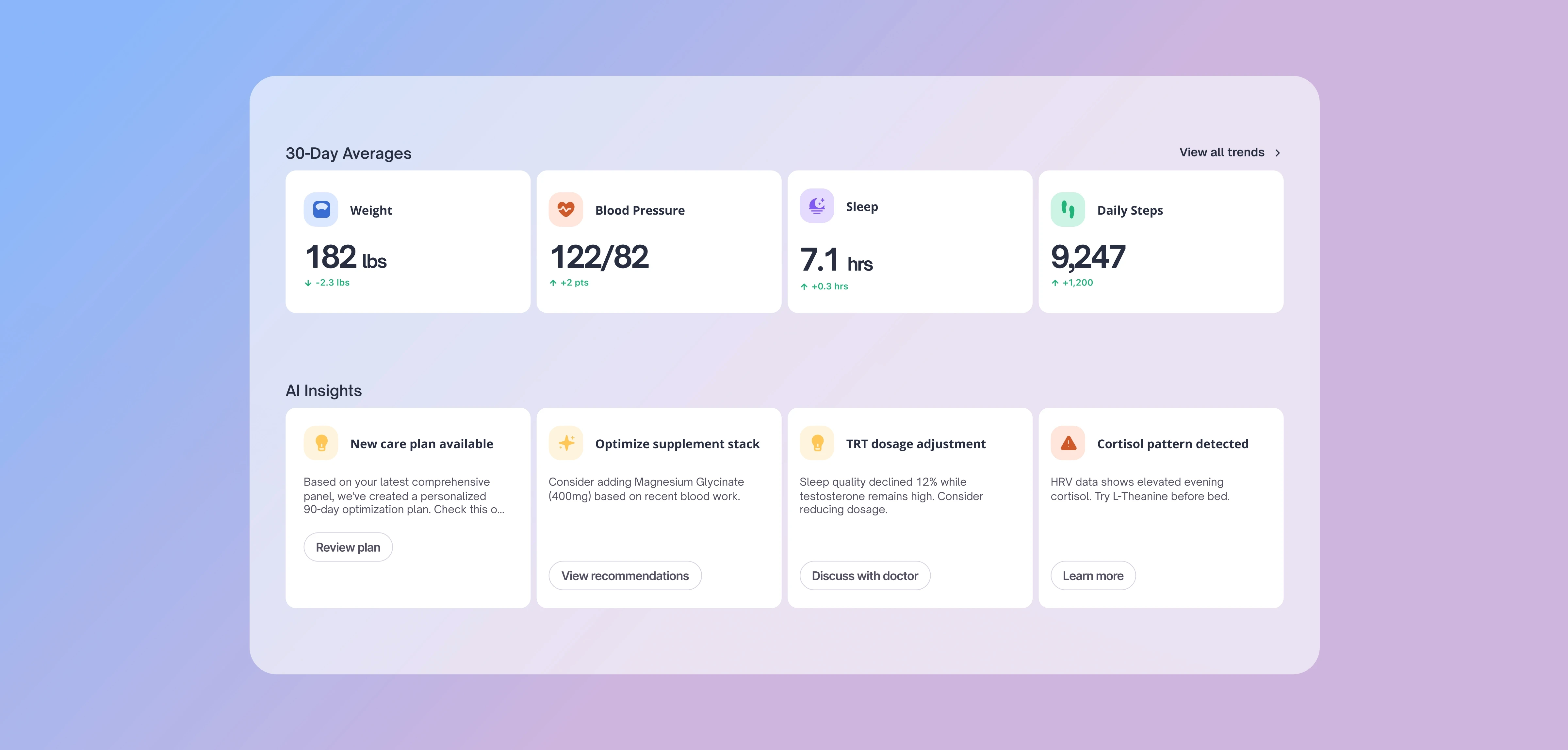
Lifelong Optimization
Not your average
Checkup
Every life stage brings new biological demands. Tracking the right metrics at the right time helps you adapt, optimize performance, and extend both lifespan and healthspan.
Traditional
Manual Data Processing
Guesswork Trend Detection
Slow Campaign Setup
Multiple Tools, Multiple Logins
Reactive Decision-Making
Manual Reporting
Delayed Results
High Error Risk
Automated Data Sync
Real-Time Trend Insights
Instant AI Optimization
All-in-One Platform
Proactive AI-Driven Strategies
Auto-Generated Reports
Instant Performance Updates
AI Precision
Frequently Asked Questions
Clarity before
you commit
Answers on setup, scale, and support to remove blockers.